
Because of my stroke, about 95% of my body doesn’t cooperate with my brain and do what it wants it to do. This includes my diaphragm, which plays a big part when it comes to doing stuff like taking deep breaths and coughing. I just breathe normally and automatically, which is a good thing! Everything else in there, like my heart and liver, apparently didn’t get the memo that something bad had just happened and have been humming along just fine ever since.
Since I can’t control my breathing, it causes several problems: Most importantly, I can’t cough and clear my throat voluntarily. It happens all by itself sometimes but there can literally be days between coughs. Having a perpetual frog in my throat gets very irritating after a while and probably annoys those around me. Secondly, not being able to breathe deeply makes it interesting at the doctor’s office when he holds the stethoscope against my chest and says, ‘OK – deep breath please.’ Not gonna happen! (Weird side note about breathing: I can inhale just fine through my nose, but not exhale. That’s why I look like a mouth breathing redneck all the time. I think it has something to do with my soft palate being paralyzed, but what do I know? I also think that’s to blame for my sleep apnea – it couldn’t be because I could stand to lose about 20 pounds!) And lastly, not having control over my diaphragm interferes with my singing so I can’t perform my favorite numbers from classic Broadway musicals, of which there are many.
Nasal suctioning – Glossary of Terms:
– Gurgly: That heavy, annoying, raspy noise that comes out of you when you have a tickle in your chest and a frog in your throat. It sounds like I’m a heavy smoker but I’ve cut back to about 3-4 cigarettes a day. When I sound gurgly, it’s time to suction. We suction at least once a day, usually more.
– Catheter: Suction catheters are these long, narrow, flexible tubes. They’re about 18” long.
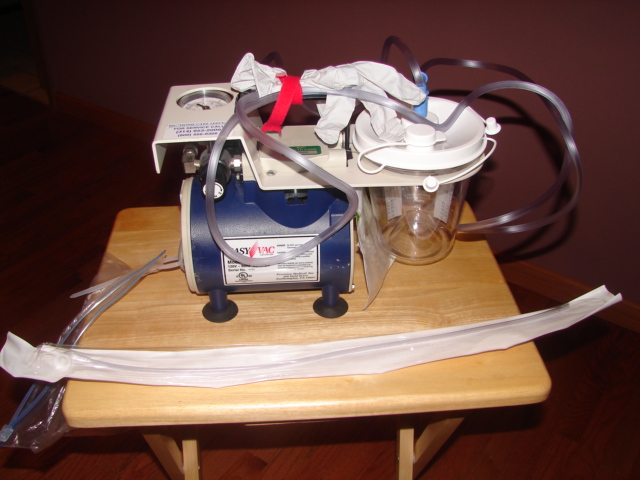
Hellboy – don’t leave home without it
– Hellboy: Our suctioning machine. It’s an electric motor with a pump attached to it that produces suction like a vacuum cleaner (hence the name, ‘suction machine’) and a reservoir that collects the “yucky stuff”. That thing gets cleaned out or replaced every three months, whether it needs it or not. (Just kidding, Jen washes it once every two weeks!) When running, it sounds like you’re standing next to a lawnmower or someone ran their RV’s generator in the campground all night.
A couple years ago I developed pneumonia and we got to spend several wonderful days in the Barnes St. Peters ICU. Actually, it’s being in the hospital that I really dislike (who doesn’t?) not the people who work there. Most nurses are great – and I’ve seen many over the years. Anyway, two good things came out of that little stint in the hospital: 1. I didn’t die 2. One of the respiratory therapists showed us nasal suctioning and how it works.
How it works:
When I get gurgly, usually after meals, it’s time to suction. Jen goes and gets Hellboy, a catheter, rubber gloves (for her, not me) and this lubricant gel that allows the catheter to slide easily up my nose. She then lays me flat into the teeth cleaning position, dons the gloves , attaches the catheter to Hellboy’s hose and lubes it up. After that she fires up the machine and the whole house shakes. The catheter goes up my nose (right nostril, if you’re curious), through my nasal cavity and down my throat. Ideally, the catheter would start to head down my trachea (windpipe), triggering a cough that clears my chest and throat. Nine times out of ten though it goes down my esophagus (stomach tube) and nothing happens. (I always thought that your windpipe was behind your esophagus but it’s the other way around, unless the poster in my GI doctor’s exam room is lying!) Anyhow, this action can be repeated many times until a cough is instigated and the whole procedure is needed usually several times a day.
I hope this post didn’t gross you out too much, if not then stay tuned for: A Quadriplegic Successfully Urinates Discretely in a Crowded Supermarket. It’s sure to be entertaining and enlightening!


 lockedinjim